QR codes are everywhere: on product packaging, restaurant menus, business cards, advertising posters, and even on architectural landmarks. This technology, invented in 1994 by the Japanese company Denso Wave, has experienced a true renaissance in recent years. Let's break down how QR codes work, where they're used, and how to create your own.
How a QR Code Works
QR (Quick Response) is a two-dimensional barcode capable of storing significantly more information than a traditional linear barcode. A standard product barcode holds about 20 characters, while a QR code can contain up to 4,296 alphanumeric characters or 7,089 digits.
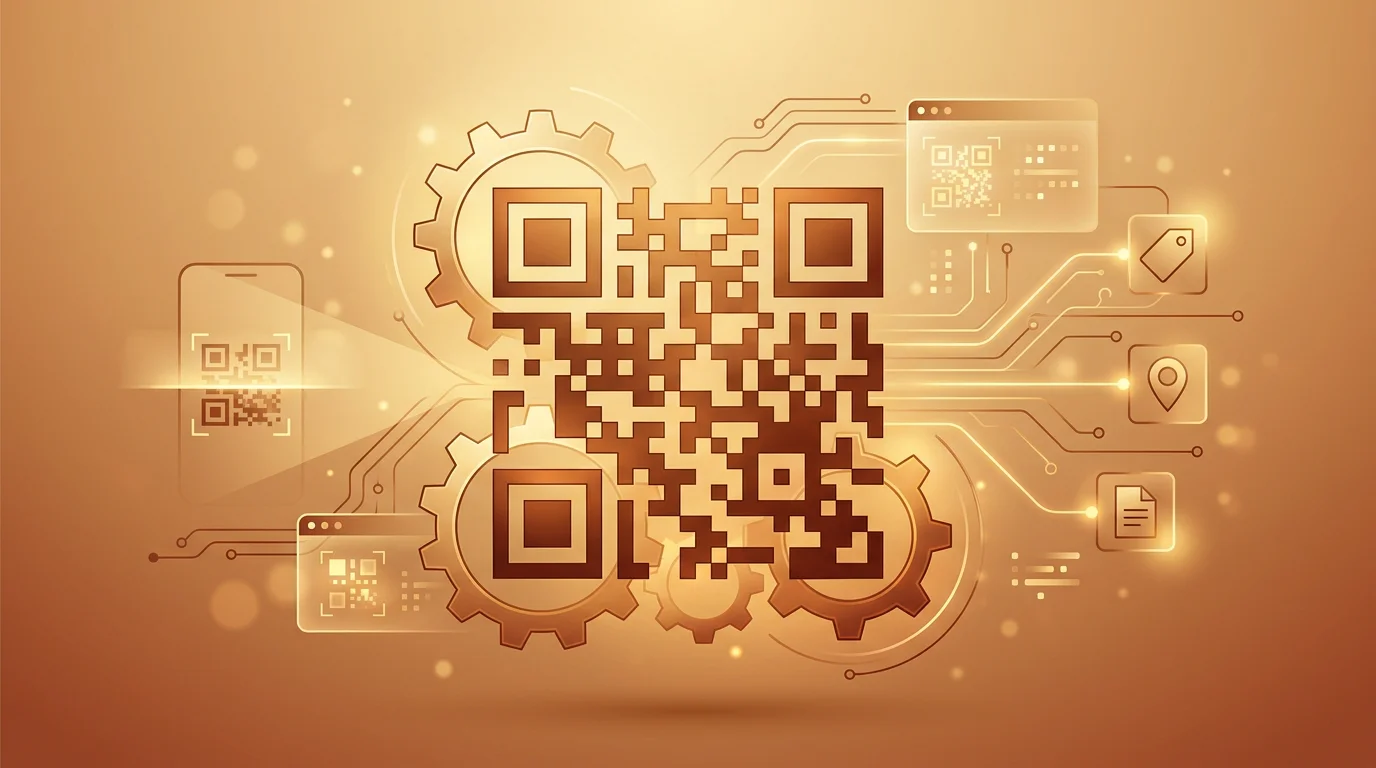
A QR code consists of black and white modules (squares) arranged in a square grid on a white background. The three large squares in the corners are position markers that help the scanner determine the orientation and size of the code. Thanks to built-in error correction (Reed-Solomon algorithm), a QR code can be read even if up to 30% of its area is damaged or obscured.
What You Can Encode in a QR Code
A QR code can contain virtually any text-based information:
- URL — the most common use case. The user scans the code and lands on a website.
- Text — any arbitrary text message.
- Contact details (vCard) — name, phone number, email, address. When scanned, the data is automatically added to the address book.
- Wi-Fi connection — network name, encryption type, and password. A guest scans the code and connects to Wi-Fi without manually entering the password.
- Email or SMS — a pre-filled email or text message.
- Geolocation — coordinates of a point on a map.
- Payment data — used in banking apps for quick transfers.
Where QR Codes Are Used
In Marketing and Advertising
QR codes are a bridge between offline and online. Place a code on a print ad, banner, or business card — and the user instantly goes to your website, landing page, or social media profile. Don't forget to add UTM tags to the link so you can track the performance of each placement.
In the Restaurant Industry
After the COVID-19 pandemic, digital menus via QR codes became the standard. They're more hygienic than paper menus, easier to update (no reprinting needed when prices change), and save servers' time.
In Logistics and Manufacturing
QR codes are used for product labeling, package tracking, and inventory management. They hold more data than standard barcodes and are scanned faster.
In Education
Teachers place QR codes in learning materials, linking to additional resources: videos, articles, interactive exercises. It's much more convenient than dictating long URLs.
In Payment Systems
Many countries now use QR codes for in-store payments and person-to-person transfers. WeChat Pay and Alipay in China operate on the same principle — QR codes there have largely replaced cash.
Static vs. Dynamic QR Codes
There are two types of QR codes:
- Static — the information is embedded directly in the code. It cannot be changed after creation. Best suited for unchanging data: contacts, Wi-Fi passwords.
- Dynamic — the code contains a short redirect URL. You can change the destination URL at any time without reprinting the QR code itself. Dynamic codes also allow you to collect scan statistics.
Tips for Using QR Codes
- Ensure adequate size. The minimum QR code size for reliable scanning is 2 × 2 cm. For advertising posters scanned from a distance, the size should be significantly larger.
- Maintain contrast. Dark modules on a light background is the standard. Inverted or colored QR codes may not be readable by some scanners.
- Add a call to action. A QR code without any explanation is a mystery. Add a label: "Scan to get 10% off" or "Open the digital menu."
- Test before printing. Always verify that the code scans correctly on multiple devices before sending it to print.
- Use UTM tags. If the QR code links to a website, add UTM parameters to track the traffic source in your analytics.
Conclusion
QR codes are a simple, free, and universal tool. They connect the physical world with the digital one, speed up interactions, and open countless possibilities for businesses. Give it a try — you'll be surprised how many tasks a small square can solve.
Create a QR code for free and without registration using our QR code generator.